
You send a message.
Two blue ticks appear.
No reply.
At first, you are fine. Maybe they are busy. Maybe they are driving. Maybe they saw it and forgot to respond.
Then five minutes become thirty.
Now your brain opens its own detective agency.
“Did I say something wrong?”
“Are they upset?”
“What if something happened?”
“Why are they online but not replying?”
Nothing dangerous has actually happened. There is no fire, no tiger, no emergency alarm. But your body may still react as if something is wrong. Your chest tightens. Your stomach feels strange. You check your phone again. Then again. Then again.
This is one of the strangest things about being human: your brain often treats uncertainty like danger.
Not because you are dramatic. Not because you are weak. Not because you “overthink too much” for no reason. Your brain is built to predict, protect, and prepare. When it cannot predict what comes next, it may start acting like the unknown itself is a threat.

Your Brain Loves Answers Because Answers Feel Safe
The brain is not just a thinking machine. It is a prediction machine.
Every second, it is trying to guess what will happen next. Will this person smile back? Will this meeting go well? Will this pain go away? Will this relationship last? Will this job be secure? Will tomorrow be better?
Predictions help you move through life smoothly. You do not have to relearn everything every day. You know that the floor will hold you, your phone will turn on, your friend will probably sound like themselves, and your usual road will lead home.
This predictability creates a sense of safety.
But uncertainty breaks that rhythm.
When your brain does not have enough information, it starts filling the gaps. And unfortunately, it often fills those gaps with negative possibilities.
Why?
Because from a survival point of view, assuming danger was safer than assuming everything was fine.
For early humans, a rustling sound in the bushes could be wind - or it could be a predator. The person who assumed “probably wind” may have relaxed too early. The person who assumed “possible danger” stayed alert and survived.
Your modern brain still carries that ancient safety system. The problem is that today’s “rustling bushes” are often things like unread messages, delayed results, unclear conversations, job uncertainty, social silence, or health worries.
Your brain is using an old alarm system in a very modern world.
The Unknown Feels Bigger Than the Bad
Here is something many people experience but rarely say out loud:
Sometimes, not knowing feels worse than knowing something bad.
Waiting for exam results can feel worse than seeing a disappointing score. Waiting for a medical report can feel worse than hearing the next steps. Waiting for someone’s response can feel worse than a clear rejection.
Why does this happen?
Because uncertainty keeps your brain stuck in multiple possible realities at once.
Maybe it will be fine.
Maybe it will be terrible.
Maybe I should prepare.
Maybe I am overreacting.
Maybe I should stop thinking.
But what if I need to think about it?
This mental switching is exhausting.
It is like having ten browser tabs open in your head, all playing different music.
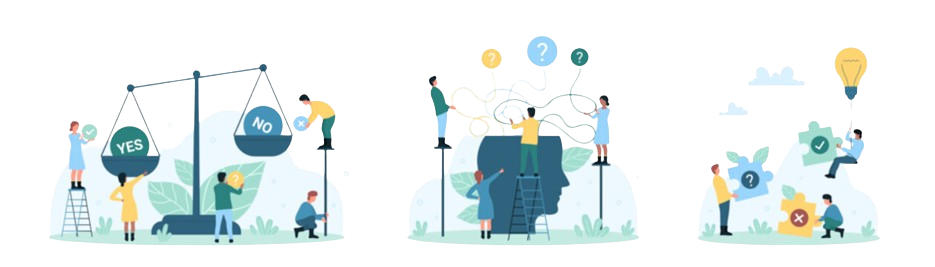
Why Uncertainty Creates Anxiety
Anxiety often grows in the space between what you know and what you fear.
When something is uncertain, your brain tries to reduce the discomfort by searching for certainty. That is why you may:
- Re-read old messages
- Ask for repeated reassurance
- Search symptoms online
- Over-plan every possible outcome
- Imagine worst-case scenarios
- Avoid making decisions
- Check notifications again and again
- Try to control things that cannot fully be controlled
These behaviors may calm you for a moment. But the relief usually does not last.
For example, you search one symptom online and feel better for five minutes. Then you find another article. Then another possibility. Then your brain says, “But how do we know for sure?”
Now you are not calmer. You are deeper in the uncertainty loop.
This is why anxiety is not always about fear of a specific thing. Sometimes it is fear of not knowing.
The Brain Confuses “Possible” With “Probable”
One of the biggest tricks uncertainty plays on your mind is making possible things feel likely.
It is possible that your boss wants to talk because you made a mistake. But it is also possible they need a quick update.
It is possible that your friend is distant because they are upset with you. But it is also possible they are tired, distracted, or dealing with their own life.
It is possible that one bad day means everything is falling apart. But it is also possible that you are simply exhausted.
An anxious brain often struggles to separate “this could happen” from “this is probably happening.”
That small confusion can create a lot of suffering.
The mind says, “If I can imagine it, I should prepare for it.”
But imagination is not evidence. A thought can be loud and still not be true.
The Need for Certainty Can Become a Trap
Wanting clarity is normal. We all want answers.
But the problem begins when the brain demands certainty before allowing peace.
You may tell yourself:
“I will relax once I know.”
“I will sleep once they reply.”
“I will feel okay once I am 100% sure.”
“I will stop worrying once nothing can go wrong.”
But life rarely gives 100% certainty.
Relationships involve uncertainty. Careers involve uncertainty. Health involves uncertainty. Money, family, plans, identity, growth - all of them come with unknowns.
If your peace depends on perfect certainty, your peace will always be delayed.
This does not mean you should ignore problems or pretend everything is fine. It means learning the difference between useful preparation and endless mental checking.
Useful preparation asks, “What is one reasonable step I can take?”
Anxiety asks, “How can I become completely safe from every possible outcome?”
One helps you move. The other keeps you trapped.

Real-Life Example: The Job Interview Spiral
Imagine Aarav has given a job interview.
The interview went well. The hiring manager smiled. They said they would get back to him “soon.”
One day passes. Then three. Then five.
Aarav’s brain starts building stories.
At first, he thinks, “Maybe they are still deciding.”
Then the uncertainty grows.
“Maybe I said something wrong.”
“Maybe they found someone better.”
“Maybe I looked underconfident.”
“Maybe my career is stuck.”
Notice how quickly the brain moves from one delayed email to an entire life prediction.
That is what uncertainty does. It turns missing information into emotional storytelling.
Aarav does not actually know the result. But his body is already reacting to rejection, failure, embarrassment, and future disappointment.
The danger is not the interview. The danger is the unknown.
How to Calm the Brain When You Do Not Have Answers
You cannot remove uncertainty from life. But you can change how you respond to it.
The goal is not to force your brain to stop caring. The goal is to teach it that uncertainty is uncomfortable, but not always dangerous.
1. Name what is happening
Instead of saying, “Something is wrong,” try saying:
“My brain is reacting to uncertainty.”
This creates distance. You are no longer inside the fear completely. You are observing it.
A simple sentence can help:
“I do not have enough information yet, and my brain is trying to protect me by guessing.”
That does not solve everything, but it softens the panic.
2. Separate facts from stories
Write two columns.
Facts:
What do I actually know?
Stories:
What is my mind adding?
For example:
Fact: They have not replied in six hours.
Story: They hate me, I ruined everything, this relationship is ending.
This exercise is powerful because uncertainty often hides inside stories. When you separate the two, the fear becomes easier to question.
A mental health journal app or AI journaling app can help with this, especially when your thoughts feel tangled.
3. Ask, “What is the next useful step?”
Uncertainty makes you want to solve the entire future.
Bring it back to the next step.
Can you send one follow-up message?
Can you wait until tomorrow?
Can you prepare for one realistic outcome?
Can you take care of your body while you wait?
Can you stop checking for the next 30 minutes?
The brain calms down when it has a small action to hold.
4. Give your body safety signals
Uncertainty is not just mental. It lives in the body too.
That is why thinking harder does not always help. Sometimes your body needs evidence that you are safe right now.
Try:
- Slow breathing
- A short walk
- Drinking water
- Stretching your shoulders
- Listening to calming music
- Guided meditation for anxiety
- Reducing caffeine when already anxious
A stress relief app, anxiety support app, or wellness app can support these small resets when your nervous system feels overloaded.
5. Practice tolerating “not yet”
One of the healthiest skills you can build is the ability to say:
“I do not know yet, and I can still take care of myself.”
Not knowing does not mean you are helpless. It means the answer has not arrived.
You can still eat. You can still sleep. You can still work. You can still breathe. You can still choose not to punish yourself while waiting.
This is not easy, but it is learnable.

Where AI Can Help With Uncertainty
When your mind is spinning, it can be hard to organize your own thoughts. This is where an AI mental health app or mental health AI chatbot can be useful — not as a replacement for human support, but as a private space to slow down and reflect.
An AI chatbot for mental health can help you separate facts from assumptions, notice repeated worry patterns, journal through uncertainty, and practice calmer responses. Platforms like ChatCouncil offer AI emotional support, self-reflection, meditation, and 24/7 mental health support in one place, making it easier to check in with yourself when your thoughts feel too loud to manage alone.
Sometimes, the most helpful thing is not instant advice. It is having a steady place to put your thoughts before they become bigger than reality.
Uncertainty Is Not the Enemy
The brain treats uncertainty like danger because it wants to protect you.
That intention is not bad. In fact, it is deeply human. Your brain is trying to keep you prepared, accepted, safe, and alive.
But protection can become pressure.
A brain that constantly scans for danger may forget that life also requires openness. Love requires uncertainty. Creativity requires uncertainty. Growth requires uncertainty. Every new chapter begins before you know exactly how it will end.
The goal is not to love uncertainty overnight. The goal is to stop treating every unknown as proof that something bad is coming.
Sometimes uncertainty means danger.
But sometimes uncertainty simply means life has not answered yet.
And while you wait for the answer, you do not have to abandon yourself.
You can breathe. You can pause. You can question the story. You can take one useful step. You can remind your brain:
“Thank you for trying to protect me. But we are safe enough in this moment.”
That may not erase uncertainty.
But it can help you stop turning the unknown into an enemy.